THE GEAR
In no particular order
01
Olympus Camedia C-700 Ultra Zoom
02
Olympus Camedia C-720 Ultra Zoom
03
Vivitar Vivicam 9114
04
Samsung Digimax 230
05
Samsung Digimax A5
06
Fujifilm Finepix AV200
07
Pentax Optio 33LF
08
Olympus Camedia C-350 Zoom
09
Samsung Digimax A7
10
Kodak EasyShare Z740
Alba Digital Camcorder TDV341
History:
Kodak DX3900 (digital)
Praktica Sport Nova Autofocus Databack (35mm)
Current 35mm:
Praktica MTL 3
Samsung AF-333
I have been somewhat interested in photography for many years, but have never pursued it as a hobby in its own right until only recently. I recall how, as a young adult of 18 years old I was suddenly able to get financial credit, especially by having no previous credit record. With this in mind I took on a mail order catalogue and bought (on credit) my first decent, and new, camera; this was a 35 mm film camera by Praktica - I think it was from their 'sport' range - it had auto-focus, databack, and a built-in flash, so I considered it to be fairly above average. At the time it cost me over ’70, and in 1985 that, for most, seemed quite a lot of money to shell out on a compact camera. However over the following few years I certainly made it work hard, and proceeded to take possibly thousands of photographs, many of which were rubbish, but some were pretty good, or so I thought. The two images of the weir at Miller's Dale on this site were taken with that camera. Then of course I had the cost of replacement batteries, camera film and processing to contend with.
Of course in this 'digital' age of the 21st Century it matters not whether the photographs taken with your 'digital' camera are any good or not, because you don't have to pay out to have them processed, or suffer the constant expense of replacement film. Times have changed, and now all we need to keep our 'digital' camera (or cameras in my case) busy is a memory card and replacement batteries - although many people now opt for the convenience of rechargeable NiMh batteries as I do.
Your camera, a couple of sets of rechargeable batteries, a battery charger, and a memory card; you're set for years. Although there's still the minor expense of the energy consumed to recharge the batteries, but if you want prints you only have to pay out for the particular prints you want, not the whole lot, or of course print them yourself. Also it is convenient to have some type of mass storage facility for your photos, such as a PC or Laptop, but in this day and age most people own or have access to such things.
Life is much easier for today's photographer than it was back then.
My aim at present is to attempt to create good photographs from basic equipment, I'm not a wealthy man so can ill afford the expense of top of the range photography equipment; a thousand pounds or more for a camera is beyond my means, so I opt for less expensive, usually second-hand cameras and do the best I can with them. Sometimes my attempts are a load of rubbish, but every now and then I get what I call 'a good 'un'; sounds much the same as something that many photographers, whether pro or amateur, often say.
I have a range of low cost cameras that for the most part satisfy my needs through their various functions. My main problem is that when I go out on a shoot I need to carry a few different cameras, one is never enough, and I dare say that by the time I've added up all the individual costs of these cameras I could have afforded to buy a much more upmarket one that did everything; but £20 for example is easy to find in one go, £1000 is a different matter - just as a matter of interest I try to avoid taking on any financial credit these days unless it is absolutely necessary - I much prefer to pay in full up front (I don't owe anyone anything then and the gear is mine to do with as I please).
My first experience with digital photography came I think around the year 2004 with a family holiday on the North Wales coast with just the built-in camera of my LG mobile phone, however we did have a couple of disposable 35mm cameras with us The photographs from the phone were OK, but at the time I had no means of transferring them on to the family computer, so they still reside on that mobile phone (still in possession, but no longer used) today. Fast forward about 6 years and I was still using a mobile phone to take photographs, this time the built-in camera on my mobile at the time, a Samsung D600, which at least had the advantage of allowing transfer of images to the PC via 'Bluetooth'. It wasn't until about a year later when I first got a 'proper' digital camera in the form of a Vivitar Vivicam 9114, given as a Christmas gift to me in 2011. I still have this camera and I do use it occasionally, but it has in the last year or so taken a back seat in preference to my other gear, it still works fine, offers 9 megapixels and is the smallest and lightest in weight of all my cameras (with the exception of the built-in ones on my two mobile phones which I very rarely use as I tend to carry at least one 'proper' digital camera along with me almost everywhere I go - even to work, after all, 'a good 'un' can appear at the most unlikely moment.
My desire to take lots of photographs effectively died with the demise of my original Praktica 35mm, but this desire was recently re-awakened within me with the launch of 'Trail Trekking' in 2011, but I only had the Samsung D600 mobile phone to take photos with at the time. The photography that accompanies my 'Trail Trekking' writings and posts is an important part of the 'Trail Trekking' package which is why I was bought the 'Vivitar Vivicam 9114' as a Christmas gift in the first place; it helped the 'Trail Trekking' cause by being easy to use and transfer the images to the PC for further use - no more slow and unpredictable 'Bluetooth' image transfers. From that moment my desire to take as many photographs as possible came back into my life with a bang. I've been taking photos en-mass ever since. 'Trail Trekking' and its more recent cousins are still my main pass-time, and photography is an important ingredient within them all; but to date my photography is becoming increasing more a part of my lifestyle.
At the present moment (time of writing) I currently own 10 digital cameras (not including the mobile phones), 2 x 35mm cameras, and 1 digital camcorder (although all the digital cameras will do some video, and the camcorder will take still photographs - but they're rubbish):
Alba Digital Camcorder TDV341
The longest-served member of my kit. Originally bought as a gift to my wife and I (when we were still together) by the same person who bought me the Vivicam as a gift a few years later. Not the smallest item but smaller and accordingly more compact than all the other 'proper' cameras with the exception of the Vivicam and the Finepix. This is one of only two of my cameras that were brand new when I first began to use them. 3 megapixels AVI video camera. It has no optical viewfinder so in use I have to rely on the lcd screen. It takes 2 x AA batteries and SD or SDHC memory cards. I usually load it with a 16gb SDHC card and carry a 8gb SDHC card as an extra should I need it. However the 16g SDHC will allow between 2 and 3 hours recording time depending on the lighting conditions.
Vivitar Vivicam 9114
The second longest served member of my kit, and also bought as a gift by the same person who gifted the camcorder. Very compact (smallest of them all), 9 megapixels. This is the one that got me foaming at the bit to go and take more photos. This is also the other one of only two of my cameras that were brand new when I first began to use them. It has no optical viewfinder so in use I have to compose my shots with the lcd screen. I takes 3 x AAA batteries and SD or SDHC memory cards. I usually load it with a 4gb SDHC card which will allow the storage of around 1780 images at its highest and largest picture quality. For about 3 years all of my 'Trail Trekking' photographs were taken with this camera. However, I have now effectively replaced this camera with my Fuji AV200, and as such this 'Vivitar' camera has mostly been retired although it still works well.
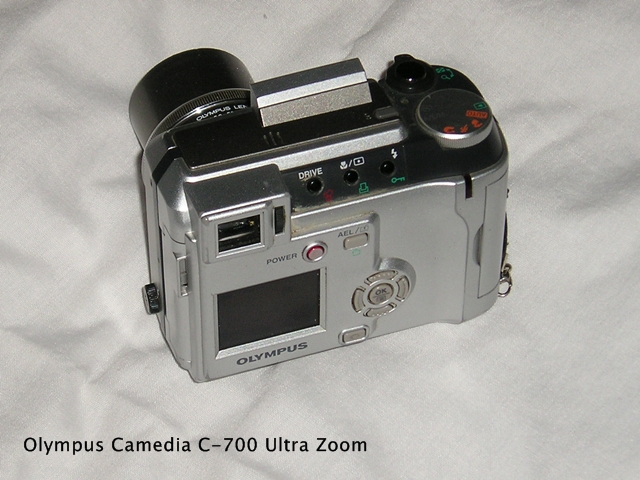
Olympus Camedia C-700 Ultra Zoom
As so called 'compact' digital cameras go this one at first seemed quite bulky but this is actually an advantage, as it limits camera shake when using the zoom facility. I purchased this in 2012. I wanted a camera that had a pretty good zoom facility without excessive expense - the zoom on the Vivitar I think is digital and as such is rubbish, this one has a 10 x optical zoom and a 2.7 x digital zoom resulting in a maximum total zoom of x 27 making it not ideal but pretty good for the money. This one cost me £20 off 'ebay', I then proceeded to spend an extra £15 on the 'SmartMedia' cards that this camera requires. It has the lcd screen like most digital cameras but also has the added advantage of a built-in viewfinder; what's more I can alter the settings by viewing through the viewfinder which is great in bright sunshine when the lcd can be difficult to see, I can even turn the lcd screen off altogether to save power if I choose.

I use the digital zoom only occasionally, but the optical zoom is adequate for most of my requirements and as it's 'optical' zoom the picture quality is retained. As a wide angle, scenic, portrait or everyday use camera this one is not very good at all; at just 2.1 megapixel the picture quality is better than expected, but it appears to have a problem with the lens which retracts and closes fine but the resulting image is left with blacked out rounded corners. However I bought it as a zoom camera and in zoom mode the black bits go away so for this purpose the camera is not bad at all.
This camera I suppose can be described as a first age bridge camera as it has quite a good selection of manual controls, though not quite SLR. I can manually set the ISO rating, use aperture or shutter priority, fully manual, or program modes, as well as adjust the exposure rating from -2 to +2. (Along with its sister, my C-720 UZ, my Samsung A5, and my Samsung A7, and very recently my Kodak Z750, I am using this to learn about manual controls). It takes 4 x AA batteries. I usually load it with a 64mb 'SmartMedia' card and carry a 32mb 'SmartMedia' card as a spare; they do not store many images but I usually only use this for zoom purposes, so large capacity is not required.
From the time of purchase up until September 2015 (when I bought my C-720 UZ) this had accompanied me on every shoot, but its almost identical sister (my C-720 UZ) is at the moment my fifth most recent camera purchase, so when I was on a holiday on the Isle of Wight as recently as August 2015 I didn't have its sister so this went with me everywhere during my holiday, along with the Alba camcorder and my Finepix. However, with my more recent purchase of its sister model - C-720 UZ - this camera is now semi-retired.
History: Kodak DX3900
Although I no longer have this camera I thought it best to include it here as some of the images displayed on this site were taken with this camera.
The story behind this one is that during June 2014 my friend, Mitch, and I took a weeks camping holiday on South Wales's Gower Peninsula, the plan being to walk the Gower coastline. We completed the coastline walk and had a few days to spare before returning home, during which time, now the coastal walk was completed, we did the holidaymaker/tourist thing. Visiting Swansea and doing a little shopping Mitch bought a 8.2 megapixel Kodak digital camera from a cash trader shop for about ’7, he still uses that camera today. Meanwhile on visiting a charity second-hand shop, although I didn't really need another camera, I still purchased this one. The camera cost just £3 and I had no idea if it worked until I returned home, and waited to receive some 'CompactFlash' cards - bought off 'ebay' - as these type of cards were required for this camera. It worked fine and from then on it accompanied me on every shoot along with the Olympus C-700 UZ and the Vivicam. One big advantage with this unit is that the resulting images were not of the usual standard ratio and could be used to print a full sheet of A4 as opposed to the usual 8 x 10.
Sadly, after over a year of service it stopped working, but I'd certainly had my £3 worth out of it and more, as I used it to take the majority of my photos. It took 2 x AA batteries, 'Compact Flash' cards and offered 3.1 megapixels, and a viewfinder. It's big advantage was the resulting images were always clear and bright. As a result of this experience I am now looking to purchase another one of this model once I've found one for a reasonable price.
Fujifilm Finepix AV200
As I was using the Kodak camera for most of my shots my use of the Vivicam was in decline, although it still went along to all my shoots. Although again I was not looking for another camera I happened to visit a second-hand shop in Chesterfield; I should have kept away because whilst in there I was drawn to this 14 megapixel Fujifilm compact camera. The guy was asking £19.95 for it, but on asking if that price was negotiable he responded with a positive. I would have happily paid the asking price but the cash I had with me was running a little low (although there was money in my bank account). To cut it short we haggled a little and agreed on £15 for the camera, bargain. I then went off to the big Tesco store and bought a 8gb SDHC card and some Duracell AA batteries for it to try it out; it worked a treat.

I was once told by a good friend that so called 'magazine' quality photography requires 12 megapixels or more so this 14 megapixel camera meant that for the first time ever I could take 'magazine' quality photos. This ultimately replaced my Vivicam on all my shoots and was usually accompanied by the Olympus C-700 UZ and the Kodak DX3900. Although I do use all of my cameras in varying degrees, this was my main 'everyday' multi-use camera, until I purchased my Samsung A5. It actually gives a good resulting image when using its built-in zoom (though still not quite as good as the Olympus), has a wide-angle in normal use, and although it is effectively my most powerful camera the AA batteries it requires (2 of them) seem to last longer than in any of my other cameras, although, mostly, it used to take the most photographs. Its main disadvantage is that it does not have any viewfinder but the large lcd screen compensates for that. It was not unusual for me to return home from a shoot with a few gigabytes of images on its 8gb SDHC card which will store around 1150 images in its highest quality and size, I would often take in excess of 300 shots in one shoot with this camera, but I used to take as many as that with the Vivicam.
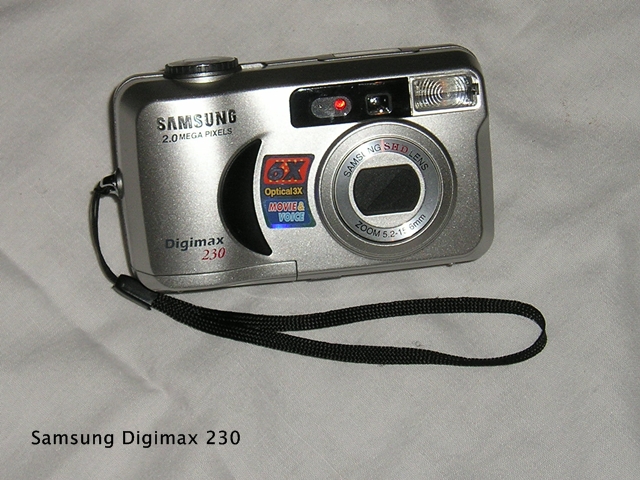
Samsung Digimax 230

The demise of my Kodak DX3900 led me to look out for another camera in which I could use the 'CompactFlash' cards originally bought for the Kodak as with it's downfall the cards were defunct as I had no other device that would take them. Some online shopping eventually got me interested in a Samsung Digimax 230 that would use the cards. About £10 off 'ebay', a few days waiting for the delivery and I then found myself the owner of this Samsung camera. On first impression it looked pretty smart, almost new, in great cosmetic condition, but rather bulky; however, it uses the 'CompactFlash' cards so I'm quite happy. This device is 2 megapixels and if I try to blow any of the resulting images up to more than their default size they do become heavily and noticeably pixelated. It took me a few goes to get used to its operation as it has a delayed shutter so I need to hold the shutter button down briefly for it to take the shot, it is not a press/click and job done. However it did come with a hard case purposely designed for this particular model and endorsed with the Samsung Digimax lettering, it also has a viewfinder, and as a bonus in some circumstances it is quite weighty (the heaviest and most bulky of them all) which helps to minimise camera shake when taking a shot, sitting securely and firmly in my hands with hardly a twitch of movement whilst I hold down the shutter button.

It uses 4 x AA batteries, and as mentioned earlier 'CompactFlash' cards, but up to a maximum capacity of 125mb; a 125mb card in this camera will store around 50 images at its highest quality and size, so I tend to carry a couple of spares when using this camera. I do take this with me on shoots occasionally, but less frequently than any of the others.
Samsung Digimax A5

A fairly recent purchase, being only a couple of months in my possession at the time of writing. To be fair for the £13 that I spent on 'ebay' to purchase this camera I have found myself the proud owner of what is generally the best all rounder multi-purpose camera of all my kit. It's only failings are the camera shake when using the zoom, often resulting in a blurred image (a standard problem with most cameras in zoom) and that by default regardless of the prior use it always reverts back to auto flash when it's switched on, but it is a quick and totally painless task to switch the flash off and takes no more than a couple of seconds; otherwise this little device is pretty good on all other counts. It is compact enough to carry about everywhere I go and I often do as this camera accompanies me almost all the time - even when not out on a shoot. It came with a purposely designed Samsung endorsed case that will sit quite happily on my trouser belt all day with no hindrance to my movement at all. It gives me bright, colourful, and sharp images with its 5 megapixels, has a viewfinder, a pretty good selection of pre-set 'scenes' such as 'landscape', 'snow', 'portrait', 'sunset' etc. plus some manual settings: aperture and shutter priority, and manual mode.

Access to any of its settings is quick and easy - making it a breeze to get to know and use, and gives me the best 'macro' shots of them all; this camera even has a little round 'selfie' mirror on the front so as you can compose a 'selfie' shot easily. This camera has a small selection of manual controls, though nowhere near SLR. I can manually set the ISO rating, use aperture or shutter priority, or fully manual, as well as adjust the exposure rating from -2 to +2. (Along with its evenly more recently purchased sister, Samsung Digimax A7, as well as my C-700 UZ and its sister my C-720 UZ, and now my Kodak Z740 I've been using this to learn about manual controls). It uses 2 x AA batteries and SD cards up to a maximum of 2gb - a 2gb card will store about 800 images of the highest quality and size for this camera. Hasten to add I am more than happy and well impressed with this purchase.
Samsung Digimax A7
An even more recent purchase, this camera is almost an exact copy of the Samsung A5, with the only difference being 7 megapixels as opposed to 5 on the A5. Otherwise this is exactly the same: same controls, same options, same size, same appearance (even down to the 'selfie' mirror on the front). It also - of course - gives great photos like its sister, uses 2 x AA batteries and SD cards up to 2gb - a 2gb card will store around 500 images at its highest and finest quality settings. Very happy with this also - however, it gets less usage than my A5 as it tends to drain batteries a little quicker and takes a couple of seconds longer to power up.
Olympus Camedia C-720 Ultra Zoom

This camera is also a recent purchase, costing £12 off 'ebay'. In almost all its features this camera is nearly an exact copy of my Olympus Camedia C-700 Ultra Zoom, except slightly more recently released, more megapixels - 3 megapixels as opposed to the 2.1 megapixels of the Olympus C-700 UZ), and slightly smaller zoom capability - 8 x optical, 3 x digital, resulting in a total zoom of x 24 (as opposed to the x 10 optical, x 2.7 digital, x 27 total of the C-700 UZ). However it does have the advantage of no blacked out corners on any of the resulting images, unlike its earlier sister. This camera I suppose can also be described as a first age bridge camera as it has quite a good selection of manual controls, though not quite SLR. I can manually set the ISO rating, use aperture or shutter priority, fully manual, or program modes, as well as adjust the exposure rating from -2 to +2. (Along with its sister, my C-700 UZ, my Samsung A5, and my Samsung A7, and now my Kodak Z740, I am using this to learn about manual controls). Otherwise it's the same: same size, shape, colour & finish, batteries (4 x AA), and cards ('SmartMedia'). Cosmetically it is in good condition and has obviously been well looked after. In tests it has performed as efficiently as its sister, but drains batteries slightly quicker - not a problem as I always carry plenty of fully charged replacements. Now this has almost replaced my C-700 UZ.
Pentax Optio 33LF
Another recent purchase is a Pentax Optio 33LF, costing £8 from 'ebay', and my first 'Pentax' camera. The 33LF has a retractable lcd that will angle to 180 degrees vertically and 270 degrees horizontally, this is great for composing shots from awkward angles, which was the purpose of my purchase; this is to save me from doing minor stunts, or uncomfortable positions to get some better shots - for example, I recall laying in the mud at Pleasley Pit Country Park to get an on-the-level shot of a pair of mute swans, and crouching uncomfortably on a rock on the beach between Shanklin and Sandown in order to get a shot of breaking waves again on-the-level, leaning out over the edge of a high rock crevice whilst holding on to a nearby tree to get that waterfall from an unusual angle - this camera is intended to make these types of shots easier and more comfortable to achieve, but only time will tell if it proves to be a wise purchase.

It is a fairly compact unit, just a little larger than my Finepix AV200, but is only 3 megapixels (same as my C-720 UZ), uses 2 x AA batteries, and will take MMC or SD cards up to 2gb. In testing I found that it works fine in bright conditions, but in shade and lower light shots that are wide (such as landscape) in which I would gain nothing from the flash, the results are dark and lack detail; in bright sunlight it's fine. I need to learn how I can set it to let in more light in the darker circumstances.
On a more positive note, the macro mode on this unit takes good photos, not quite as good as the Samsung A5, but certainly second in the macro rankings (but it is 2 megapixels less than the A5). Also of course its usefulness will become apparent as I attempt shots from otherwise awkward or inconvenient angles
Olympus Camedia C-350 Zoom
My second most recent purchase, the C-350 Zoom is merely a point and shoot camera of 3 megapixels. To be honest I had no particular reason for buying this as I would gain nothing from it, but the shop was only asking £2 for it, so what was I supposed to do? They even gave me a 1 year warranty on it. However, I needed a XD card for it, so when I eventually got one I got out and tested it in the field; and I'm pleased to say that the resulting images were pretty good. This camera has no manual control whatsoever and is simply a point and shoot, doing everything automatically within camera. It is fairly compact and has almost the same dimensions as my Samsung A5, it takes 2 x AA batteries and XD Picture Card up to 256mb. As I do not have any 256mb XD cards I load it with a 128mb XD card - the only XD card I possess, which will hold about 80 images.
Kodak Easy Share Z740
My most recent purchase. Although I am more than happy with my Olympus C-720 UZ, the fact that it uses 'SmartMedia' cards does cause a few issues; these card are becoming rarer and more expensive. So I have been on the look out for another 'bridge' camera that will take the more modern SD cards, and I've found one. Keeping on a minimal budget I've managed to purchase this 5 megapixel 'bridge' camera for just £9.98 from 'cashgenerator.co.uk'. This offers another - old, but still more modern than my C-720 UZ - camera that gives me both manual and auto settings, and so aiding the learning curve some more. Plus as it takes the SD cards, although in modern terms it is outdated, it should keep me going for some time. It takes 2 x AA batteries, and will give me 10 x optical zoom like my C-700 UZ, and more auto and manual options than both my C-700 UZ and C-720 UZ with the added advantage of more megapixels, so would be better for larger images or cropping.

In tests it has performed remarkably well; it takes good quality images, the settings and controls are a breeze to access - no having to go into the menu to change anything like my Olympus C-700 UZ and C-720 UZ - a flick of a switch will put it immediately into video mode, and its design makes it easy to use. A 2gb SD card in it will store well over 1,000 images. Hasten to add, another purchase I'm more than happy with.
Just for the record, even now my Samsung Digimax A5 does most of the work, taking the most photographs, quite possibly more than all the others put together.
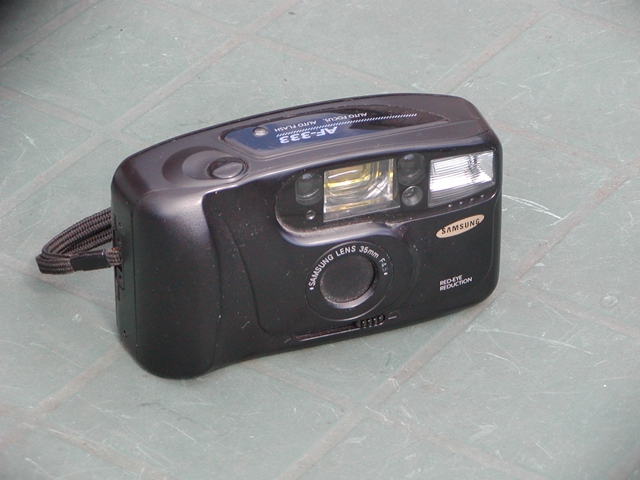
I also own two 35mm film cameras; a Samsung AF-333 compact camera, and an old fully manual Praktica MTL 3 SLR with 2 lenses. I rarely use either of these cameras, but they're available if I fancy a go.
Accessories
Learning about manual controls I made the conscious decision to purchase a few filters for my Olympus C-700 UZ and C-720 UZ. Much of my photography is 'landscape' so my first purchases were a ND (neutral density) and a CPL (central polarising) filter. The ND filter allows me to use longer exposure in most light conditions (except night time - don't need a ND filter for long exposure then), the CPL filter allows me to pick up more vivid colour and minimise unwanted reflections (such as from water or metal surfaces); but I have had to buy an adapter tube in order to use the filters. Then I bough 3 x star filters (4, 6, and 8 point) - good for creating a star effect from reflective or direct light or sparkle.
Fortunately the adapter tube that I will need to purchase for my most recent Kodak Z740 will accept the same size filters as the tube for the C-700 UZ and C-720 UZ, so once I've got the adapter tube at least I will not have to buy new filters as the ones I've already got will serve for both.

Using long exposures and getting sharp photos really requires the help of a tripod to stabilise the camera. I've had a small bendy leg mini tripod for some time but I need to stand it on a convenient secure surface to use (not easy when the only such surface available on location is something like the top of a fence post, wall, or litter bin, and of course all at the most inconvenient height so I'm forced to ache my back using such things). This is no longer a problem as a month ago I bought a full height (well full height for someone who is only 5 foot 6 - that's me) tripod. It is wonderful though a bit cumbersome and a nuisance to carry about if I need to walk some distance from the car to my shooting location, but it serves its purpose well.
Soon this will not be a problem either as I've ordered an 'octopod'/'gorillapod' flexi mini tripod off 'ebay', just waiting for it to be delivered. This will be much easier to carry around and will be of use anywhere as it can wrap tight or tie to almost any inanimate object that happens to be there.
Next proposed accessory purchase: a 'Cokin' style filter holder and adapter, along with a few graduated ND filters (great for landscapes).
Why a 'Cokin' style filter holder and adapter?
Because you can't get round graduated ND filters, you can only get square/oblong ones.